
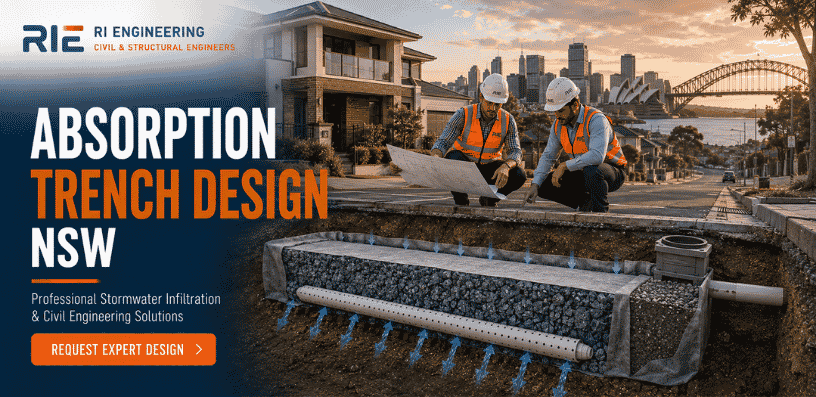
Absorption Trench Design NSW: When Civil Engineers Choose Infiltration Over OSD
Absorption trench design in NSW is a way made by civil engineers that many homeowners do not think about, but it can help save a lot of money compared to using a large tank under the ground. At R I Eng Pty Ltd, we look at how water soaks into the ground and how well these systems work for homes all over NSW. This includes houses, townhouses, duplexes, and granny flats. Whether you can use an absorption trench on your site will depend on the type of soil you have, the size of your area, and what your council says you can do. Here is what the engineering process has in it.
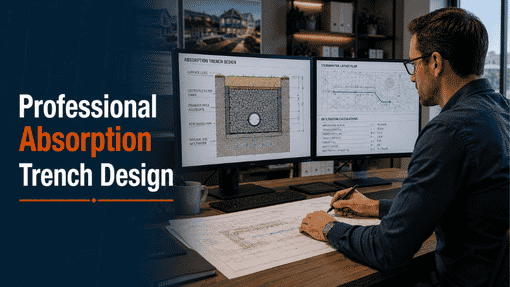
What Is an Absorption Trench and How Does It Work?
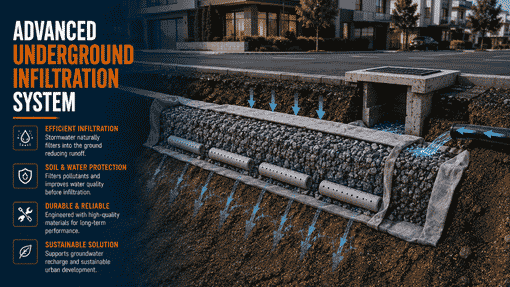
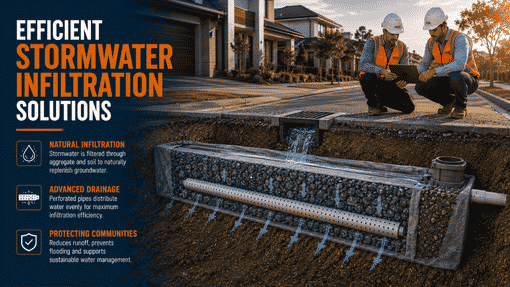
An absorption trench is a simple way to handle water under the soil. It lets stormwater soak into the earth instead of sending it to the council’s pipes. The trench is filled with large rocks and covered with a special fabric. Water flows in through a pipe with small holes. Then the water spreads out over the rocks and slowly moves into the soil around it.
This system works well on sites where the soil lets water in at a safe rate. Sandy soils in the Northern Beaches, Sutherland Shire, and some parts of the Central Coast are a good fit for this. Clay-heavy sites in western Sydney take in water very slowly. These sites usually need OSD instead.
When Do NSW Engineers Recommend an Absorption Trench Instead of OSD?
Not every site is good for an absorption trench. R I Eng looks at several things before they say yes to infiltration instead of a detention system.
Soil permeability is the first thing we check. We do or look at percolation test results for the site. A percolation test shows how fast water moves through the soil where we want to put the trench. Sandy soil lets water go through fast. Thick clay does not let the water move.
Site area matters. A trench needs to be long enough to spread out the amount of water it gets. A small granny flat might have enough open space and dirt for a short trench. Bigger houses or duplexes often need longer systems or more than one trench.
Council rules are different. Some NSW councils let you use an absorption system as the only way to get rid of stormwater if your site fits their rules. Other councils ask you to use both absorption and an overflow pipe to the kerb or to the council’s pipes. R I Eng will check your council rules before they suggest a system for you.
Setback rules need to be followed. Trenches have to be at least a certain distance away from building footings, edges, and all current systems that move water away. We think about these distances as we plan how to lay out the trench right from the start.

What Does an Absorption Trench Design NSW Include?
A civil trench for water soak-away from R I Eng Pty Ltd includes the following:
A percolation check or a review of test data that is already there. Calculations for trench size use design rainfall and how well the soil lets water in. A drawing to scale that shows where the trench is, its size, how high and low the pipe levels are, and how far things are set back. A list of the rocks and cloth layers needed. A plan for what happens when the trench is full in a big storm.
The overflow detail is important. There is no system for water absorption that can take in all rainfall. Every good trench has a way for extra water to flow out. This path should lead the water to a place where it is legal to send it. This helps keep the property and nearby homes safe when there are heavy rains.
Houses, Townhouses, Duplexes and Granny Flats: Which Projects Suit an Absorption System?
Granny flats are the most common way people use this. A granny flat adds a small roof. If the ground lets water in, a short soakage trench is enough to take care of the extra water from rain. You do not need a tank for this.
Houses on sandy land can often get this, especially when they take down and put up a new house where the old draining system used to soak water into the ground. R I Eng checks the width of the ditches again for the new space.
Townhouses and duplexes on areas where water can sink in can use soaking to handle water from roof spaces that are shared. But you will need a longer trench for the water to go through. You also have to plan to make sure water goes the right way for each home.
Attached dwellings that are on sites with a lot of clay do not work well with soakage alone. R I Eng will check the ground early so you are not left waiting for a system that will not fit your site.
5 Questions About Absorption Trench Design NSW
Q: How do I know if my soil is right for an absorption trench?
You need a percolation test at the spot and depth where the trench will go. R I Eng can help you with the testing and tell you what the results mean for your area.
Q: Is an absorption trench cheaper than an OSD tank?
If the site meets the rules, yes. There is no tank to buy or put in. The digging part is also simpler. The money you save depends on how long the trench has to be and the type of soil you have.
Q: Can a granny flat use an absorption trench in NSW?
Yes, if the site lets water go through. R I Eng will check the roof size, how well the soil lets water pass, and how long the trench can be. Then, they make sure the system will work before they design it.
Q: What happens to the trench during heavy rainfall?
A well-designed trench for water includes an overflow outlet. When the soil in the trench can’t take in any more water during a strong storm, water will move safely to a discharge point that is allowed by law. This stops it from coming back up onto your land.
Q: Does R I Eng Pty Ltd design absorption systems across all of NSW?
Yes. R I Eng works in Greater Sydney, Newcastle, Wollongong, and other parts of NSW. You can contact us to talk about your place.
Talk to R I Eng Pty Ltd About Your Site
Absorption trench design NSW is not always the same for everyone. The best system depends on your soil, the size of your area, and what your council needs you to do. Getting these three things right at the start can stop you from running into costly changes later.
📞 Call us: +61 0451 452 932
💬 WhatsApp Us: Chat on WhatsApp
📧 Email: riengineering2155@gmail.com
🌐 Visit: riengineering.com.au