
Hydraulic Modelling NSW: What the Engineer Is Actually Doing Behind the Software
Hydraulic modelling NSW is a term you might see in engineering quotes or council papers. Most people do not know what it means or why they have to pay for it. If you are getting a stormwater drainage design in NSW, this is about what a civil engineer does and why it is important for your project.

What Is Hydraulic Modelling — and Why Does Your Project Need It?
Hydraulic modelling NSW engineers use a computer to show how water flows in a drainage system when there is a storm. This model uses details like your site’s catchment area, pipe sizes, pit spots, surface grades, and overflow paths. Then, it looks at rainfall data to show what will happen during a real storm.
It tells us one main thing: will the drainage system work, or will it not?
Without the model, an engineer just guesses. With the model, the design gets real numbers to back it up. The council certifiers and private certifiers ask to see this proof before they give a construction certificate. The model output goes into your compliance paperwork.

Which Software Do NSW Hydraulic Engineers Use?
DRAINS is the most used stormwater software for how water moves in NSW. Most local councils take DRAINS output as is. It can work with pipe networks, how pits work, how water goes over land, and OSD numbers, all in one model. R I Eng Pty Ltd uses DRAINS for homes, duplexes, townhouses, and granny flat water flow designs in Greater Sydney and NSW.
TUFLOW works with bigger and harder flood situations like flood models for whole catchments, mapping how water flows over land, and looking at floodplains. A TUFLOW model becomes useful when a flood engineer needs to show how development fits in with a larger floodplain, not just pipes at the site.
ILSAX is an older model that you can still see in some council documents. Most engineers who do modern work in NSW now use DRAINS. It has taken the place of ILSAX for standard work with drains.
The rational method is a simple way to work out runoff for small areas. Engineers often use it when they want a fast answer. But in Sydney, councils now ask for a full DRAINS model for most development plans. A rational method by itself is not enough for council approval.

What Does the Hydraulic Modelling Process Look Like?
At R I Eng Pty Ltd, the stormwater flow study goes through a clear order:
Step 1 — Site data collection. We need your survey, the site area, the planned layout, and the connection point to council pipes.
Step 2 — Catchment setup. In this step, we say what the sub-catchments are. These are the areas that send water to each pit. We also put in the percentage of roofs, driveways, and paving that do not let water go through.
Step 3 — Pipe and pit network entry. You need to enter the size, length, slope, and type of each pit for every pipe into the DRAINS model.
Step 4 — Rainfall input. We use the design storm from the Bureau of Meteorology IFD data for your place. Most NSW councils ask for at least the 1-in-20-year and 1-in-100-year storms.
Step 5 — Model run and check. DRAINS runs a model that shows how water moves in the system. We look for any pits that flood, pipes that fill up too much, and any overflow paths that can bring flooding.
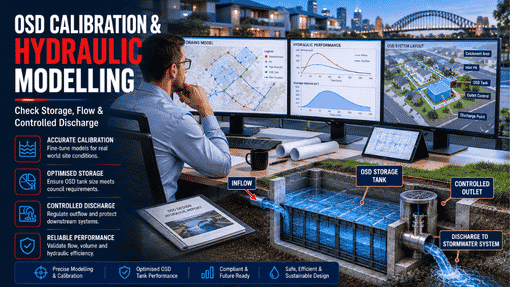
Step 6 — OSD calibration. When your project needs on-site detention, we use the DRAINS OSD module. This helps us check if the size for water storage and outlet meets what the council allows for the site discharge rate.
Step 7 — Report output. The model results go into the report that we send with your plan for how water moves.
The whole process works with real engineering facts. It does not use guesses.

Which Projects in NSW Need Hydraulic Modelling?
Most homes and businesses in Greater Sydney now need a DRAINS model for their system. This includes:
- New homes and knockdown rebuilds — when OSD is needed, DRAINS is needed too
- Granny flats and smaller homes — if the council asks for OSD checking, modelling is done after
- Duplexes and homes for two families — two roof areas that go to the same system need modelling to show it works well
- Townhouses and joined homes — shared water pipes need a model that gets checked by a pro
- Any site close to a waterway — flood engineers may need TUFLOW for testing how water flows over land
Simple sites with small catchment areas and no OSD can use rational method calculations only. R I Eng Pty Ltd will check what type of modelling is needed. They will do this based on details from your council and your site before they start.
5 Questions Clients Ask About Hydraulic Modelling in NSW
Q: Does every plan for stormwater in NSW need DRAINS modelling?
Not every design needs this. Small and simple sites sometimes use an easier method for their calculations. Most homes in Greater Sydney that need OSD will need a DRAINS model. Your local council’s DCP will say what is needed, and R I Eng Pty Ltd checks this before sending you a quote.
Q: What is the main way DRAINS and TUFLOW are not the same?
DRAINS is used to plan and design pipes, pits, and on-site detention on a site. TUFLOW is used to check how floods move over large areas like catchments and floodplains. Most homes and small projects use DRAINS. But if a project is close to a waterway or on a floodplain, TUFLOW may be needed.
Q: How long does hydraulic modelling take?
For most homes, including a house, granny flat, or townhouse, it takes about two to three business days to do the modelling and write the report. R I Eng Pty Ltd gives you this in the full package for design.
Q: Who reviews the DRAINS model output?
The main person signing off on your project looks at the model output, and this is included with the paperwork for your building certificate. In some cases, the council checks this right when you apply to build. The model needs to follow all of the technical rules set by the council.
Q: Does R I Eng Pty Ltd provide the water flow report with the water plan?
Yes. Every stormwater drainage design from R I Eng Pty Ltd comes with all the needed math and model results for your certifier. There is no need to ask for anything extra. You get the whole package together.
Work With R I Eng Pty Ltd on Your NSW Hydraulic Modelling
R I Eng Pty Ltd offers civil stormwater design and water modeling for both homes and businesses in NSW. It does not matter if you need help with a new house in Blacktown, a granny flat in Parramatta, a two-home build in Penrith, or a townhouse project in the Hills District. Our team gives you certified DRAINS models and water flow plans that can be sent in right away.
📞 Call us: +61 0451 452 932
💬 WhatsApp Us: Chat on WhatsApp
📧 Email: riengineering2155@gmail.com
🌐 Visit: riengineering.com.au
Tell us what your project is and where it will be. We will tell you what is needed for the model, and we will start working on your water flow papers quickly.