

OSD Design Penrith: The Western Sydney Guide You Should Read Before Your CC Is Due
OSD design Penrith catches people off guard. Every week, someone calls us after their certifier has flagged missing on-site detention documentation — and the construction certificate is weeks away. It is stressful. It is avoidable. And it happens because a lot of people in Penrith still believe that brand-new estates like Jordan Springs or Glenmore Park handle stormwater at the developer level, so individual lot owners do not need to worry about it.
That is not how it works.
Whether your lot came from a master-planned estate or a backyard subdivision in Kingswood, Penrith City Council holds individual landowners responsible for managing their own site’s stormwater runoff. OSD design Penrith is a civil engineering requirement. R I Eng Pty Ltd handles the civil design side — the hydraulic calculations, the drawings, the tank specification. We do not guide you through council approval processes. What we do is produce OSD documentation so complete and technically accurate that your certifier has everything they need without chasing us for more information.
What Is OSD and Why Does Penrith City Council Require It?
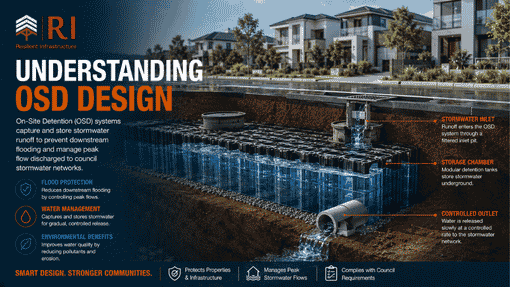
OSD stands for on-site detention. Think of it as a temporary holding tank built into your property. When heavy rain hits, the tank collects stormwater runoff from your site and releases it slowly — at a controlled rate — into the council drainage system.
Penrith is growing fast. New roofs, new driveways, new paved areas — all of that replaces ground that used to absorb rainfall naturally. Multiply one development by thousands across the LGA, and the council’s existing pipes and channels face significantly more load than they were built for.
OSD design Penrith is the civil engineering solution to that problem. Each site manages its own excess runoff. The downstream system stays within design capacity. Flooding risk drops. That is the intent, and it works — when the OSD design is done correctly.
What Penrith City Council’s OSD Requirements Actually Mean for Your Project
Penrith City Council sets specific on-site detention standards in its Development Control Plan. Here is what those standards require in plain terms.
Your site cannot discharge more than a set flow rate during a storm. This rate — called the Permissible Site Discharge, or PSD — is calculated based on your site area. Penrith has its own PSD table. It is not the same as Blacktown’s or Parramatta’s. Using the wrong council’s figures produces a non-compliant design.
The OSD tank must hold the difference. Whatever your developed site produces above the PSD rate during a 1-in-100-year storm event, the tank must contain it. R I Eng calculates this volume using DRAINS hydraulic modelling. The model runs pre-development and post-development scenarios for your specific site and determines the exact detention volume required.
The outlet controls the release rate. A slotted pit or orifice plate sits at the tank outlet. It restricts the flow so the tank empties slowly after the storm passes. If the outlet is the wrong size, the entire system fails — either it restricts too much, and the tank overflows, or it releases too fast and defeats the purpose.
Flood-affected Penrith sites need extra work. Parts of the Penrith LGA sit within or near the Hawkesbury-Nepean floodplain. For these sites, the OSD design for Penrith requires additional hydraulic analysis. The OSD outlet must function correctly even when downstream drainage is surcharging during a flood event. This is more complex than standard OSD design, and R I Eng handles both the OSD and the flood hydraulics together as one coordinated civil design package.

Who Needs OSD Design in Penrith?
Here is a direct answer — because vague guidance wastes time.
New homes and knockdown-rebuilds: Yes. Always. A new dwelling adds roof area and typically a new driveway. OSD is required.
Granny flats and secondary dwellings: Yes — if the granny flat adds a meaningful roof or paved area to the site. Most do. R I Eng confirms the specific requirement based on your address and proposed works.
Duplexes and dual occupancies: Yes. Two dwellings mean more combined roof area and a shared drainage system. The OSD calculation reflects the combined impervious coverage.
Townhouses and multi-unit developments: Yes. These carry the most complex OSD requirements because large combined catchments, communal driveways, and shared underground drainage all feed into a single OSD system.
Home extensions: Depends. Adding a first-floor extension over an existing footprint often does not change the OSD picture much. Adding a large ground-floor addition with new roof area and new paving usually does. Call us — we give clear answers quickly.
Commercial developments: Yes. These also carry water quality requirements on top of standard OSD, depending on the site use and catchment sensitivity.
What R I Eng’s OSD Design Penrith Package Includes
R I Eng Pty Ltd produces civil engineering documentation. Our OSD design Penrith package gives your certifier and builder everything they need in one place.
DRAINS hydraulic model outputs — pre and post-development runoff calculations for your site, demonstrating the required detention volume for the 1-in-100-year storm event using Penrith’s council parameters.
Engineering drawings — tank dimensions, location on site, inlet and outlet configuration, overflow routing, and connection to the stormwater drainage system. Drawn in AutoCAD to council drafting standards.
Outlet structure specification — the orifice plate or slotted pit design, sized to Penrith’s permissible site discharge rate. Not a generic detail. Calculated for your specific site.
Overflow routing — what happens when the tank reaches capacity. Water still needs a defined path that does not cause damage to your property or your neighbours’.
Builder installation notes — material specifications, installation sequence, inspection hold points. A plumber or builder who has not installed OSD before can follow these without guessing.
That last point matters. An OSD tank installed at the wrong invert level will not detain the correct volume. Your certifier checks the OSD installation. Fixing it after backfilling costs significantly more than getting the documentation right up front.

Typical OSD Tank Options for Penrith Residential Sites
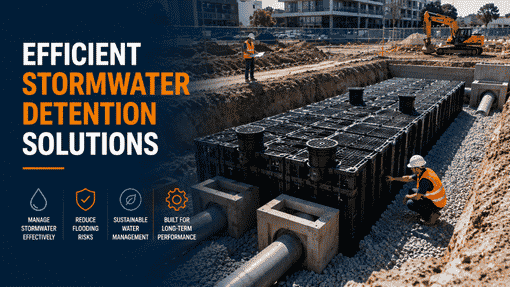
Underground polyethylene tanks are the most common choice for Penrith residential developments. Western Sydney blocks tend to be larger than inner-city lots. There is usually room for the tank under the driveway or in the rear yard without losing usable space. Polyethylene tanks are cost-effective, widely available, and suitable for most residential OSD volumes in the Penrith LGA.
Precast concrete tanks suit situations where the required volume is large, where the tank sits under heavy vehicle loading, or where the site conditions do not suit polyethylene. Higher cost, but appropriate for the right application.
Tanked basement voids apply to highly constrained sites. The basement structure itself serves as the detention volume. This approach needs careful hydraulic and structural coordination. R I Eng handles the hydraulic side and coordinates with your structural engineer on the basement design.
R I Eng recommends the right tank type for your site. We explain the trade-offs clearly before committing to a design direction. You make an informed choice — not a guess.
Questions Penrith Clients Ask R I Eng About OSD Design
Q: My estate developer told me stormwater is handled at the estate level. Do I still need OSD for my individual lot?
Yes. Estate-level infrastructure manages drainage from common areas and roads. Individual lot developments still generate runoff from roofs and driveways. Penrith City Council holds individual landowners responsible for managing that runoff through OSD. Estate-level infrastructure does not replace individual lot OSD requirements.
Q: How does R I Eng calculate my OSD tank size?
We run a DRAINS hydraulic model using your site survey data and Penrith City Council’s OSD parameters. The model calculates pre-development and post-development runoff volumes. The difference — at the 1-in-100-year storm level — determines the tank size. We do not use rule-of-thumb estimates. Every OSD volume is site-specific.
Q: My Penrith property is near the Nepean River. Does that change the OSD design?
Yes. Sites near the Nepean River or South Creek sit within or near the Hawkesbury-Nepean floodplain. The OSD design must account for the possibility that downstream drainage is surcharging during a major flood. This requires additional hydraulic analysis. R I Eng prepares both the OSD civil design and the flood hydraulics together — you do not need separate consultants for each.
Q: How long does OSD design for Penrith take?
Two to three business days for most residential Penrith projects once we receive your survey data. If your deadline is tighter, tell us when you call. We will confirm whether we can meet it before you commit to anything.

Talk to R I Eng About Your Penrith OSD Design
📞 Call R I Eng Pty Ltd: +61 0451 452 932 📧 Email: riengineering2155@gmail.com 🌐 Website: riengineering.com.au
R I Eng Pty Ltd produces civil engineering designs — OSD systems, stormwater plans, drainage layouts, and hydraulic modelling — for residential and commercial developments across Penrith and the broader western Sydney region. If your project needs an OSD design in Penrith, get in touch. We confirm requirements fast, design accurately, and deliver documentation that works.