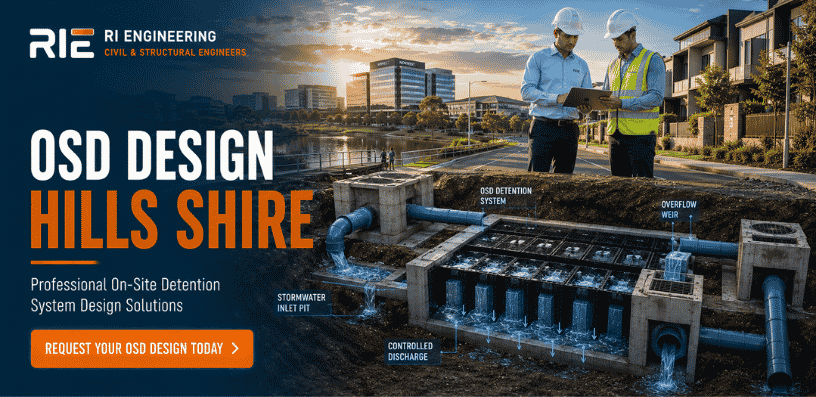
OSD Design Hills Shire: What the Engineering Actually Involves
OSD design Hills Shire is something most homeowners in Castle Hill, Baulkham Hills, and Kellyville only hear about when their certifier flags it — usually at the worst possible moment. Hills Shire Council has some of the most detailed on-site detention requirements in Greater Sydney. If your development adds new roof area, paving, or hard surfaces, you almost certainly need an OSD system engineered and documented before your construction certificate is released.
At R I Eng Pty Ltd, we design OSD systems for residential projects across the Hills District. Here is a plain explanation of what the engineering involves and why it matters for your project.
What Is OSD and Why Does Hills Shire Require It?
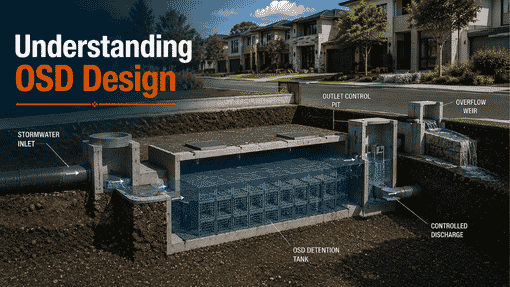
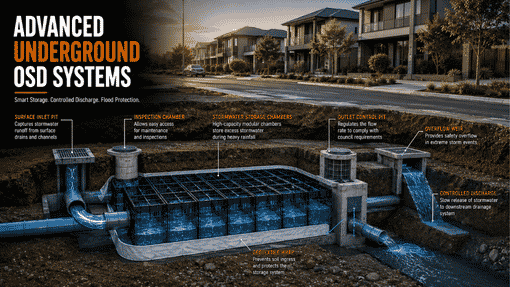
OSD stands for on-site detention. It is an underground tank that collects stormwater runoff from your property and releases it slowly into the council’s drainage network.
Every new development adds hard surface — roofs, driveways, concrete paths. Rain hits these surfaces and runs off immediately, instead of soaking into the ground. Hills Shire Council requires OSD design because the combined effect of thousands of new homes releasing runoff at once would overwhelm the drainage network. Your OSD tank absorbs the surge and lets it out at a controlled rate, protecting downstream properties and council infrastructure.

What Makes Hills Shire OSD Engineering Different?
Hills Shire OSD engineer requirements differ from neighbouring councils. Hills Shire Council sets specific permissible site discharge (PSD) parameters — these are the maximum flow rates your site can release during a storm. The Hills Shire PSD parameters depend on your site area, and the detention volume must match the 1-in-100-year storm event.
Using the wrong PSD figures produces an undersized tank. An undersized tank fails at council review. R I Eng Pty Ltd applies Hills Shire’s current DCP parameters to every Hills District detention design we produce — not a generic template from another LGA.
Which Projects in Hills Shire Need OSD Design?
Most residential projects that increase impervious area need OSD. In practice, this includes:
Houses and knockdown-rebuilds — new roof area always triggers OSD requirements in Hills Shire.
Granny flats and secondary dwellings — even a smaller secondary dwelling adds roof and paved area. Castle Hill OSD engineering applies to these projects too.
Duplexes and dual occupancies — two dwellings on one site mean a larger combined catchment and a more involved detention calculation.
Townhouses and attached dwellings — shared drainage infrastructure with coordinated OSD design across the whole development.
If you are unsure whether your project triggers OSD, a quick call to R I Eng Pty Ltd gives you a clear answer in minutes — no guesswork, no lengthy back-and-forth.
How R I Eng Pty Ltd Designs OSD for Hills Shire
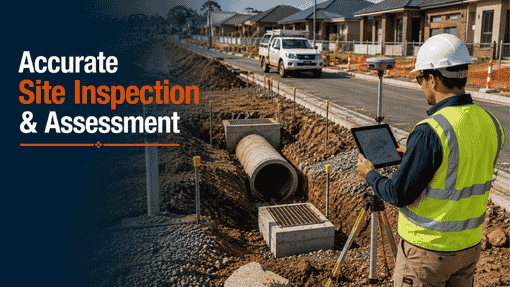
We start with your site survey and your council’s current DCP parameters. We run a Hills Shire DRAINS model to calculate your pre-development and post-development runoff. From that model, we determine the Hills District OSD volume your site requires. We then design the tank, the OSD outlet Hills Shire standards require, and the overflow routing — all in a single engineering package.
Most residential OSD designs for Hills Shire projects are ready in two to three business days. The package includes engineering drawings, hydraulic calculations, tank specifications, and installation notes your builder can follow on site.
The detention tank Castle Hill sites typically use is an underground polyethylene tank beneath the driveway or rear yard. It keeps your usable outdoor space intact while satisfying council’s requirements.
5 Quick Questions About OSD Design Hills Shire
Q: Does Hills Shire require OSD for a granny flat?
Yes — if the granny flat adds meaningful roof or paved area, Hills Shire requires OSD as part of the stormwater design. R I Eng Pty Ltd can confirm this for your specific site within minutes.
Q: How is the OSD tank size calculated for Hills Shire?
We use DRAINS hydraulic modelling with Hills Shire’s specific PSD parameters. The tank volume depends on your site area, impervious coverage, and the design storm event — not a standard rule-of-thumb figure.
Q: Can the OSD tank sit under the driveway?
Yes — and this is the most common placement for Hills Shire residential sites. It keeps the rear yard usable and gives easy access for the builder during installation.
Q: Does a duplex in Hills Shire need a shared OSD system?
Yes. A duplex or dual occupancy shares one OSD system that covers the combined catchment of both dwellings. R I Eng Pty Ltd coordinates the drainage layout across both lots as part of the one design package.
Q: How long does OSD design take for a Hills Shire project?
For most houses, granny flats, and duplexes, we deliver the completed design within two to three business days of receiving your site survey.
Talk to R I Eng Pty Ltd About Your Hills Shire Project
R I Eng Pty Ltd provides OSD design and civil drainage engineering for residential projects across the Hills District — Castle Hill, Baulkham Hills, Kellyville, Rouse Hill, Norwest, and surrounding suburbs.
📞 Call us: +61 0451 452 932
💬 WhatsApp Us: Chat on WhatsApp
📧 Email: riengineering2155@gmail.com
🌐 Visit: riengineering.com.au
Tell us your site address and what you are building. We will confirm whether OSD is required and give you a clear quote — fast.