
Drainage Plan for Parramatta: What No One Else Will Tell You Before You Lodge Your DA
Getting a drainage plan for Parramatta sorted is one of those things that sits near the top of the to-do list — but often gets pushed down until your certifier or council sends back a request for additional information. By then, your project timeline is already taking a hit. After more than a decade working on civil drainage across western Sydney, I can tell you that the developers and homeowners who move fastest are the ones who understand exactly what a drainage plan involves before they start — not after.
So let me walk you through it properly.

What Is a Drainage Plan for Parramatta, Really?
A drainage plan for Parramatta is not just a drawing of where the pipes go. It is a full hydraulic engineering package that shows council and your certifier how every drop of rainwater falling on your site will be collected, controlled, and released — and why the design will work during a major storm, not just a light shower.
A proper drainage plan for Parramatta typically covers:
- Stormwater pipe layout and sizing — the diameter, gradient, and material of every pipe on site, calculated to carry the design storm flow without surcharging
- Pit locations and types — grated inlet pits, junction pits, and sediment arrestors positioned where the drainage actually needs to work
- Surface drainage grading — finished levels and surface slopes that direct water toward collection points, not toward your neighbour’s fence
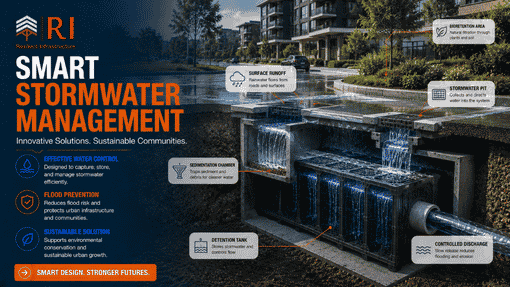
- OSD (On-Site Detention) design — the underground tank that temporarily holds your site’s excess runoff and releases it slowly, which Parramatta City Council requires for virtually every development that increases hard surface
- Overflow routing — what happens during a 1-in-100-year storm when the pipes are at capacity. This is the part that gets skipped in cheap designs and causes problems years later
- Hydraulic modelling — using software like DRAINS to prove the system performs as designed under real storm conditions
- Connection to council infrastructure — the exact point and method of connecting your site drainage to the council’s street system, which needs to comply with Parramatta’s specific connection standards
Every single one of those elements matters. Leave one out, and the council will ask for it — usually right before your construction certificate is due.
Why Parramatta Drainage Plans Are More Complex Than Most People Expect
Parramatta is not a flat, simple suburb where you just run a pipe to the curb. The LGA covers everything from the flat river corridor near Church Street to rolling residential streets in Northmead and Winston Hills. Catchment interactions between older and newer developments, aging council drainage infrastructure in established suburbs, and Parramatta Council’s detailed DCP requirements all combine to make drainage plan design here genuinely technical work.
Then there is the OSD calculation. Parramatta City Council has its own permissible site discharge (PSD) parameters — the maximum flow rate your site is allowed to release during a storm — and the OSD tank needs to be sized to contain everything above that rate during a 1-in-100-year event. Those parameters are specific to Parramatta. Using Sydney City or Blacktown figures by mistake is a common error in outsourced designs, and it results in a non-compliant submission every time.
At RI Engineering, we keep Parramatta’s current DCP parameters on file and apply them directly. It sounds like a small thing. It saves a lot of resubmission time.

Who Actually Needs a Drainage Plan for Parramatta?
Honestly, most people building or renovating in the LGA do. Here is a practical breakdown:
New homes and knockdown-rebuilds: Yes. Every time. New roof area, new driveway, and new OSD required.
Granny flats and secondary dwellings: Yes — if the dwelling adds a meaningful roof or paved area, Parramatta requires drainage documentation as part of the CDC or DA.
Duplexes and dual occupancies: Yes, and these are more involved because you have two separate roof structures feeding into a shared drainage system that still needs to connect cleanly to council infrastructure.
Townhouses and multi-unit developments: Absolutely yes. Shared underground drainage infrastructure, communal driveways, large combined roof catchments — the complexity goes up considerably.
Commercial developments: Yes. Parramatta’s commercial areas are growing fast, and the drainage requirements for commercial sites include water quality treatment measures that residential projects do not typically need.
Home extensions and additions: Depends on the scale. Adding a second storey does not always change the drainage picture dramatically, but adding a ground-floor extension that increases paved area often does. If you are not sure, call us — it takes five minutes to give you a clear answer.
How RI Engineering Prepares Your Parramatta Drainage Plan
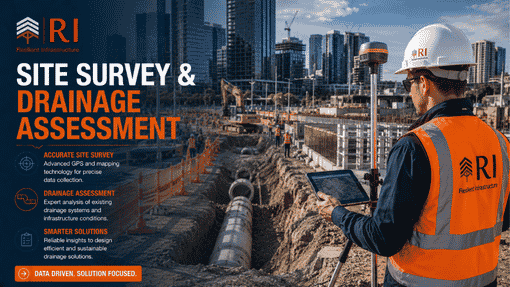
We do not work from templates. Every drainage plan for Parramatta we produce starts with your site survey data and your council’s current requirements — not a generic drawing from a previous project that someone has renamed.
Here is what our process looks like in practice:
We start by reviewing your survey, identifying your discharge point, and checking Parramatta City Council’s drainage mapping to confirm there are no unusual constraints on your site. From there, we design the drainage layout in AutoCAD — pipe sizes, pit positions, surface drainage grades, and OSD location — and run the DRAINS hydraulic model to confirm the system works for Parramatta’s design storm events.
Most residential drainage plans for Parramatta projects are ready within two to four business days from the point we receive your survey. For urgent projects, faster turnaround is possible — just let us know your deadline when you call.
Parramatta Homeowners and Developers Ask Us Most
Q: Does Parramatta City Council always require OSD, or only for larger projects?
OSD is required for virtually all developments in Parramatta that increase impervious area — that includes single homes, granny flats, and duplexes, not just medium-density developments. The threshold is low, and if in doubt, assume you need it. RI Engineering will confirm for your specific site and calculate the exact volume required.
Q: Can I use the same drainage plan for my DA and my construction certificate?
In most cases, yes, though the CC stage sometimes requires additional detail on inlet and outlet levels. RI Engineering designs drainage plans that work across both stages wherever possible, which saves you the cost of a full redraw later.
Q: What if the existing drainage on my street is old or undersized?
This is more common in Parramatta’s older, established suburbs than people realize. Where existing council infrastructure has capacity issues, we design your site drainage to connect to the best available discharge point and document the connection properly. In some cases, council may require a formal drainage upgrade as a condition of consent — we will flag this risk before you lodge if it is relevant to your site.
Q: My builder said he can handle the drainage plan. Should I let him?
Builders can coordinate the documentation process, but the drainage plan itself must be prepared by a qualified civil engineer, not a draftsperson or the builder directly. The engineering calculations, DRAINS modelling, and hydraulic report that Parramatta Council expects are engineering work, full stop. If your builder has a good civil engineer they regularly work with, that is fine. If they are trying to do it themselves to save money, that is a red flag worth taking seriously.
Ready to Move Forward?
📞 Call RI Engineering: +61 0451 452 932 📧 Email: riengineering2155@gmail.com 🌐 Website: riengineering.com.au
If you have a Parramatta project coming up and need a drainage plan sorted properly. From a team that knows Parramatta City Council’s requirements and has the track record to back it up — get in touch today. We turn drainage plans around fast, and we get them right the first time. We explain what we are doing at every step so you are never left guessing.